Michael Alley, Penn State
Writing as an Engineer or Scientist
  • Home
    • Scientific Presentations
    • Scientific Posters
    • Scientific Film
  • Writing Topics
    • Writing with Artificial Intelligence >
      • Strong Examples of AI Writing >
        • AI Example: Marketing Analysis
        • AI Example: Report Summary >
          • Full Report
      • Improvement of AI Writing
    • Grammar >
      • Section 1: Grammar
      • Section 2: Punctuation
      • Section 3: Usage
      • Comprehensive Quiz
  • Writing Documents
    • Reports >
      • Reports Tutorial: Short >
        • Reports Tutorial: Full
      • Report Formats >
        • Sample Report Format
        • Report Templates
      • Laboratory Reports
      • Design Reports
    • Emails >
      • Tutorial: Emails
      • Writing Professional Emails
      • Writing Professional Letters
    • Research Papers
  • Teaching Resources
    • Teaching Writing in the Age of AI
    • Short Films
    • Canvas Quizzes for Report Tutorials
    • Craft of Scientific Writing >
      • Lessons >
        • 2: Being Precise and Clear
        • 3: Avoiding Ambiguity
        • 4: Sustaining Energy
        • 5: Connecting Your Ideas
        • 6: Being Familiar
        • 9: Emphasizing details
        • 10: Incorporating Illustrations
      • Errata
    • Why Our Students Struggle With Scientific Writing

Writing Professional Letters

  Sender's Address 
  Date of Letter
Recipient's name 
Recipient's title 
Recipient's company 
Recipient's company address 

Recipient's Name:
​
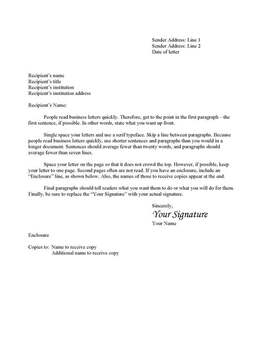
     People read business letters quickly. Therefore, get to the point in the first paragraph--the first sentence, if possible. In other words, state what you want up front.

     In this format, which arises from a combination of professional formats, you should single space your letter and use a serif typeface. Skip a line between paragraphs. Because people read business letters quickly, use shorter sentences and paragraphs than you would in a longer document. Sentences should average fewer than twenty words, and paragraphs should average fewer than seven lines.

     Space your letter on the page so that it does not crowd the top. However, if possible, keep your letter to one page. Second pages often are not read. If you have an enclosure, include an “Enclosure” line, as shown below. Be sure to mention the enclosure in the body of the letter. Also, appearing at the end are the names of those to receive copies.
​
     Final paragraphs should tell readers what you want them to do or what you will do for them.

Sample Cover Letter
Tutorial on Writing Cover Letters
Professional Letter Template
Picture
Sincerely,                   
Signature               
Name  
                      

​Enclosure. 

Copies to: Name to receive copy
​                   Additional name to receive copy

Leonhard Center, Penn State 
University Park, PA 16802

Content Editor:

Michael Alley
​
[email protected]